
Project Concept
B2B | UX | Systems
Published On
Jan 2026
Reading Time
5 min read
For years, sitemaps have been treated like a formality. They’ve been designed to explain structure rather than strategy and show hierarchy without revealing intent.
Useful on paper, but kept more like documentation.
Most sitemaps explain what exists, not why it exists. They document pages, but ignore how humans actually think, scan, hesitate, and decide.
In B2B, where attention is scarce and trust is earned slowly, every decision has a risk attached.
So we stopped treating the sitemap like documentation and rebuilt it as a decision-making system.
What Is a Sitemap? (And Why It’s Not Enough)
Traditionally, a sitemap is a visual map of a website’s pages and their relationships.
They are created to bring clarity across teams.
Designers use them to understand layout hierarchy.
Developers reference them to plan routing and architecture.
Stakeholders rely on them to get a sense of scope before the project moves forward.
What they rarely capture, however, is how users actually move, pause, and decide within that structure.
That said, Most sitemaps are organisational tools but a very few are behavioural ones.
The Limits of Traditional Sitemaps in B2B
Traditional sitemaps list pages, whereas a B2B UX sitemap models how buyers evaluate risk, build trust, and gain confidence over time
Most sitemaps assume websites are consumed logically and sequentially:
Homepage → Features → Pricing → Conversion.
That assumption breaks down the moment stakes are high.
Humans don’t experience websites as structured hierarchies. We experience them as fragments.
We skim for relevance, scan for credibility, and jump between sections in search of reassurance. Attention moves quickly, guided less by structure and more by signals of trust, familiarity, and perceived effort.
When decisions carry risk, people rely on mental shortcuts:
They prefer clarity.
Recognisable patterns over layouts.
Social proof
Instead of reading every page, buyers assemble understanding through repeated exposure and validation.
Traditional sitemaps ignore this reality. By treating every page as equal, they fail to distinguish between pages that reduce anxiety and pages that require deep conviction.
As a result, traditional sitemaps answer only one question:
"What pages exist?"
And miss out on the more critical one:
"How those pages work together to support human decision-making."
Reframing the Sitemap with B2B Information Architecture Thinking
One of the core assumptions we challenged was the idea of an “ideal user flow.”
Instead of treating the sitemap as just a structural artifact, we combined traditional sitemap structure with information architecture to create a hybrid model, that reflected how users orient themselves.
As a result:
Trust is built
Complexity is introduced in steps
Decisions are nudged forward.
To do this, navigation paths were treated as behavioural signals.
Each page was no longer just a label. It was crafted with intent, depth, and effort.
You could immediately see:
Which pages required explanation.
Which demanded proof.
Which existed purely to reduce friction.
With this approach, the sitemap stops being a list of pages and becomes a representation of how thinking unfolds.
How we Created an Effective UX Sitemap?
Our approach didn’t come from a borrowed framework or a predefined UX model. It emerged from repeatedly encountering the same structural failures and choosing to address the root cause instead of the symptoms.
By redefining what a sitemap is responsible for, we changed its role entirely.
Our guiding principles were:
Every page must serve a clear cognitive purpose
If it doesn’t reduce confusion, build credibility, or move a decision forward, it doesn’t belong in the system
Page importance is defined by mental effort, not hierarchy
This shifted the sitemap from a record of pages to a hybrid model of reasoning.
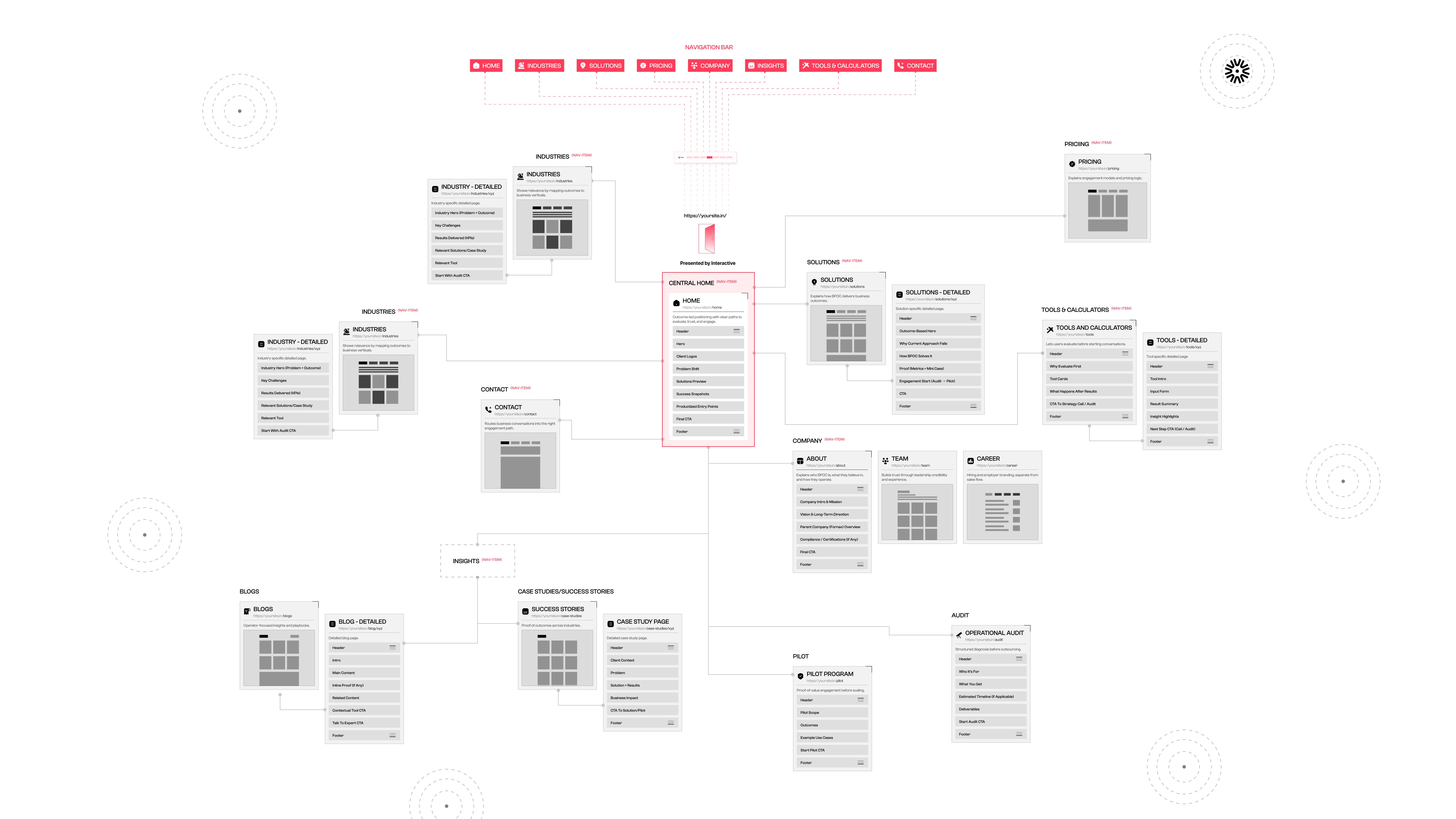
To make that difference visible early, we embedded low-fidelity wireframes directly into the sitemap as signals of content density, hierarchy, and cognitive load.
This allowed the sitemap to communicate how heavy or light a page was before design or copywriting even began.
What Changed After We Rebuilt the Sitemap?
Once the sitemap reflected intent and effort, conversations shifted immediately.
Content scope became clear earlier
Overloaded sections surfaced before design
Pages were no longer added “just in case”
While traditional sitemaps optimise for structure we designed one to support decision-making, with Information Architecture governing how trust, proof, and evaluation were revealed over time.
Instead of asking users to commit before they were ready, the structure created multiple ways to build confidence and move forward at their own pace.
The sitemap moved beyond being a reference document and became a strategic system that shaped behaviour, clarified priorities, and influenced the website long before the first screen was built.
When structure starts supporting how people think, the website stops asking for attention and starts earning decisions.
Frequently Asked Questions about B2B UX Sitemaps (FAQs)
What is a B2B UX sitemap?
A B2B UX sitemap goes beyond listing pages. It models how buyers evaluate risk, build trust, and gain confidence across multiple visits before making a decision.
How is a B2B UX sitemap different from a traditional sitemap?
Traditional sitemaps document structure. B2B UX sitemaps represent behaviour, cognitive effort, and decision sequencing.
What do you mean by a “Decision-First” sitemap?
A Decision-First sitemap prioritises intent, effort, and cognitive load over page count or hierarchy.
Instead of asking “What pages should exist?” , we ask “What does the buyer need to understand, believe, or feel confident about at each stage?”
Structure follows decisions, not the other way around.
How does this sitemap improve B2B website performance?
By aligning structure with how people actually decide, the sitemap helps:
Reduce confusion and drop-offs
Surface proof and reassurance earlier
Prevent content overload
Support multiple decision paths instead of a single “ideal” flow
Does this approach affect design and content?
Yes, since cognitive effort is visible at the sitemap stage, teams can scope content more accurately and Identify high-effort pages early. This would also help designers avoid overloading the design with last minute additions.
Is this approach suitable for all B2B websites?
This approach works best when:
Decisions are high-stakes
Multiple stakeholders are involved
Trust needs to be earned over time